Blossom-end rot on tomatoes: a dark, sunken patch on the fruit
Blossom-end rot is a dark, sunken, leathery patch on the bottom of a tomato, the end opposite the stem. It is not a disease: the developing fruit runs short of calcium because water reaches it unevenly, even though the soil usually has plenty. Keeping the soil evenly moist is the main way to prevent it, and peppers and zucchini can get it too.
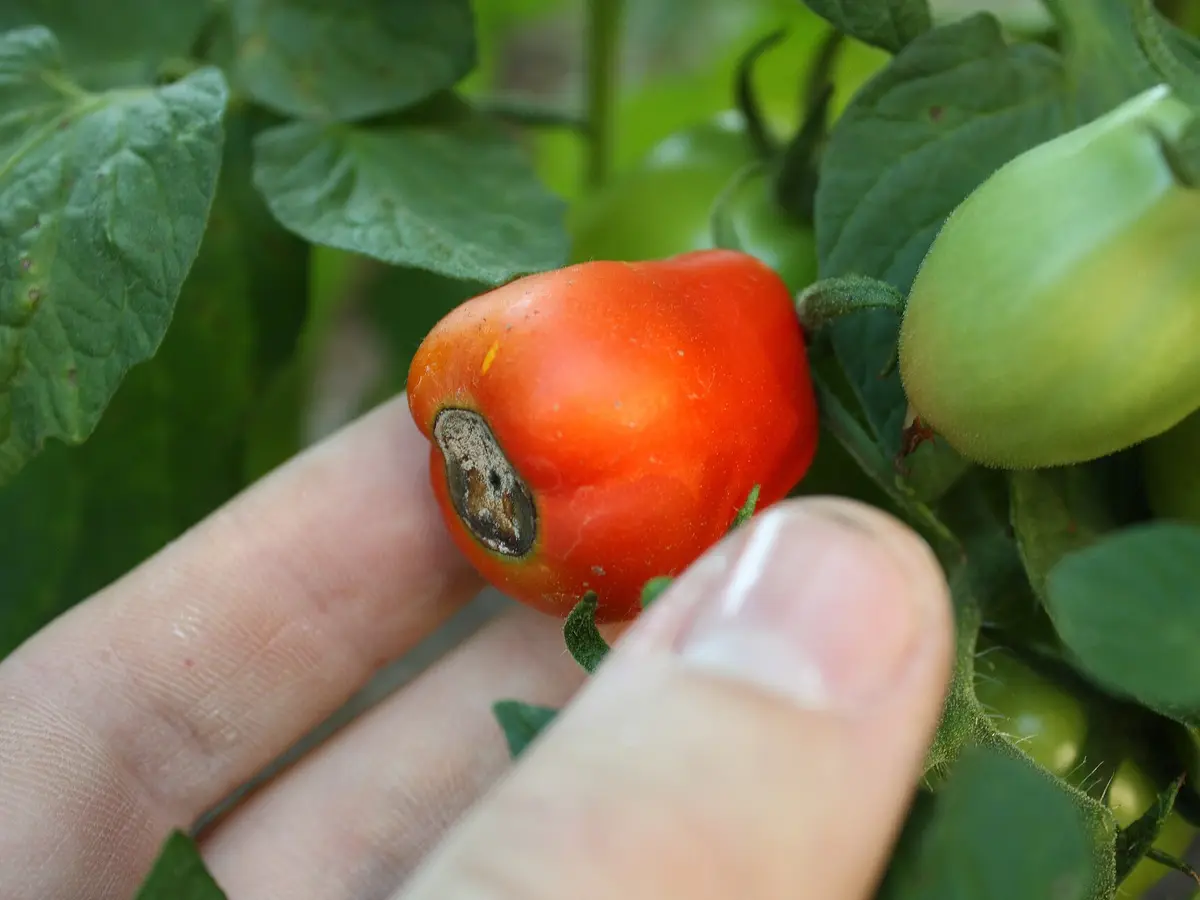
What does it look like?
- A small, water-soaked or light brown spot at the bottom of green fruit, often when the fruit is about a third to half grown.
- The spot spreads into a sunken, leathery, brown or black patch as the fruit ripens.
- Several fruits on the same plant affected at once, while the leaves look healthy.
- Sometimes hard, brown areas inside the fruit, with or without a patch outside.
Why does it happen?
- Uneven watering, especially a dry spell after a period of fast early growth.
- Plants in pots or grow bags, where limited root space makes the water supply less steady.
- Heavy nitrogen feeding, fertiliser added to dry soil, or salty soil, which all make it harder for water and calcium to reach the fruit.
- Hot, dry winds; sandy soil; and some varieties, which are more affected than others.
What can you do about it?
- Keep the root zone evenly moist: water deeply and regularly, so the soil neither dries out nor stays soggy, and water more often in pots during hot weather.
- Mulch around the plants to hold moisture and even out soil temperature.
- Follow the recommended rate for fertiliser, avoid heavy nitrogen, and never feed plants when the soil is dry.
- Remove affected fruit if you like; the patch will not heal. Fruit that forms once watering is steady has a better chance.
- Next season, plant in well-drained soil, out of strong winds where you can, and try a variety less prone to it.
When you photograph a plant with this problem, Leafsight gives an assessment that names the likely problem, how serious it looks and how sure it is. Your first assessment that finds a problem includes care steps like these; with Pro or a one-time unlock, every one does.
When should you look closer?
- On a tomato, patches on the side of the fruit, or rot that spreads to the leaves and stems: that points to a disease such as blight rather than blossom-end rot. Mould on an old blossom-end patch is common and moved in afterwards.
- The problem every year despite steady watering: a soil test can show whether calcium or salt is actually the issue.
Questions
What causes blossom-end rot on tomatoes?
Blossom-end rot happens when the developing tomato runs short of calcium at the end farthest from the stem. The soil almost always has enough calcium; what fails is the flow of water that carries it to the fruit, so uneven watering, dry spells, pots with little root space, heavy nitrogen feeding and hot, dry winds all make it more likely.
Should I add calcium to stop blossom-end rot?
Usually not. Soils, potting mixes and grow bags very rarely lack calcium, so blossom-end rot nearly always comes from water reaching the fruit unevenly rather than from too little calcium in the soil. Steady, deep watering and mulch help most. If it keeps happening despite even watering, a soil test can show whether calcium or salt really is a problem.
Will blossom-end rot spread to my other tomatoes?
No. Blossom-end rot is not caused by a fungus or bacterium, so it does not spread from fruit to fruit or from plant to plant, and there is nothing to spray. Several fruits can show it at once because they formed during the same dry spell. Fruit that develops once the watering is steady has a better chance of being unaffected.
Why do tomatoes in pots get blossom-end rot more often?
Tomatoes in pots and grow bags have little root space, so the soil dries out quickly and the water supply swings between wet and dry. That uneven flow of water is what stops calcium reaching the fruit and causes blossom-end rot. Water potted tomatoes more often in hot weather, use a large container, and mulch the surface to slow drying.
Not sure? Check with a photo
Leafsight looks at a photo of the leaf, asks a few questions about light, watering and drainage, and gives an assessment of the likely problem with care steps. A photo assessment can be wrong: for a hands-on look, ask a local garden centre or plant clinic.
Related problems
- Tomato blight: early blight and late blight, and what to do
- Overwatered or underwatered? How to tell the difference
- Broad mites on peppers: curled new leaves and bronzed fruit
Sources
- UC IPM: Blossom end rot
- RHS: Blossom end rot
- Oklahoma State University Extension: Common tomato problems (Grow column, July 2026)
Updated 2026-11-04. All plant problems.
Also in: Español · Deutsch · Français · Português (Brasil) · 简体中文 · 日本語 · 한국어