Broad mites on peppers: curled new leaves and bronzed fruit
Broad mites are mites far too small to see without magnification that feed on the newest growth of peppers and many other plants. Their saliva makes young leaves curl down and turn stiff, narrow and bronzed, and fruit grow rough, russet skin, so the damage is often mistaken for herbicide injury, a nutrient problem or a virus.
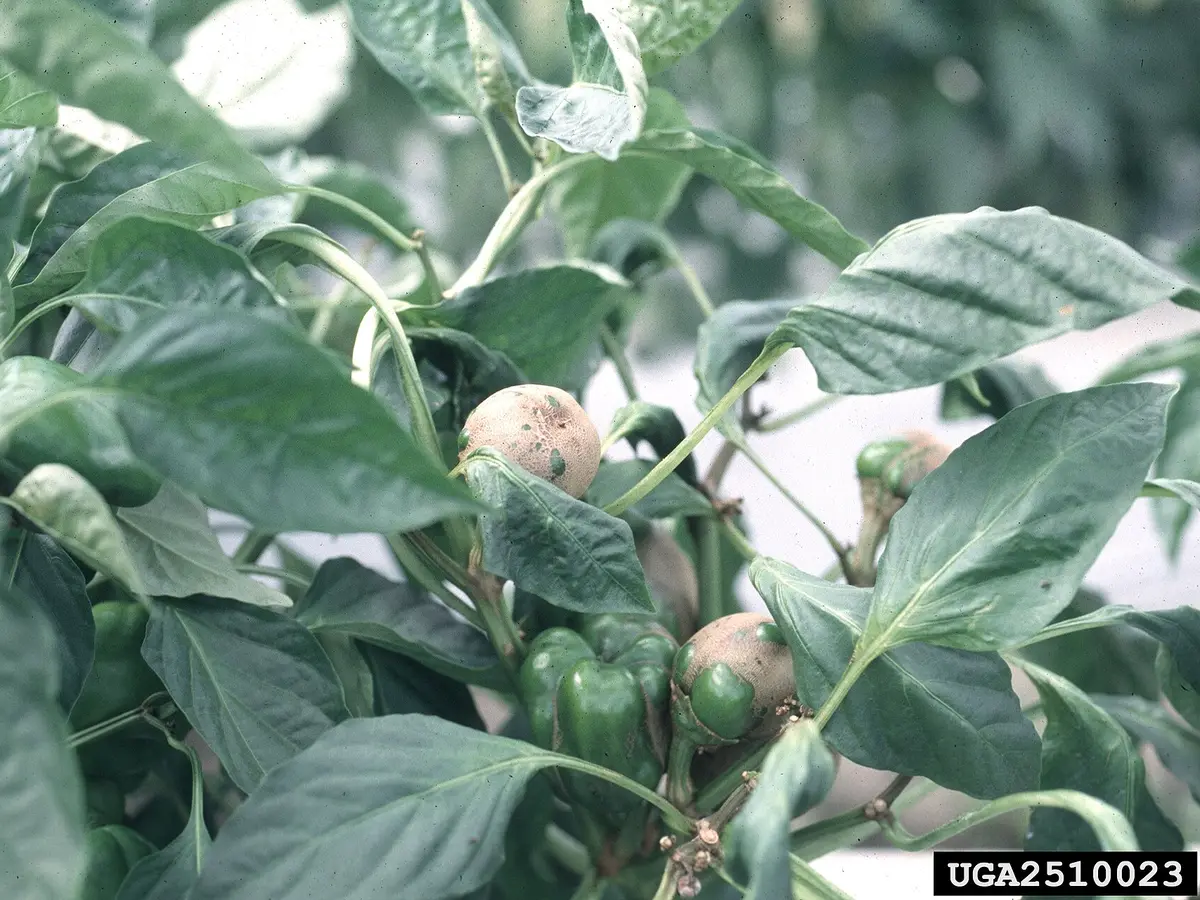
What does it look like?
- New leaves curled downward, stiff, narrow or strap-like, while older leaves look normal.
- A bronze or russet sheen on young leaves and stems.
- Rough, russet patches on the fruit, and flowers or small fruit dropping.
- Stunted, distorted shoot tips, with no webbing and no pest you can see.
Why does it happen?
- Warm conditions in a greenhouse, indoors or outdoors in warm climates; where winters are cold, outdoor plants usually get the mites from infested transplants.
- Infested transplants or a new plant brought in with the mites on it; on peppers the damage often shows only once the plants set fruit.
- Mites moving to plants nearby, on touching leaves or carried by whiteflies, which is why healthy plants should not stand next to infested ones.
What can you do about it?
- Check the newest leaves and flower buds with a strong hand lens: broad mites are tiny and pale, and they leave no webbing.
- Remove heavily infested plants and put them in the bin, taking care not to brush them against other plants.
- Keep new or affected plants apart from healthy ones, and start next season from clean transplants.
- If the mites persist, an insecticidal soap or horticultural oil can help: they work only where they touch, so cover the shoot tips and buds, and do not use them on dry, stressed plants or in hot weather. For a miticide, choose one whose label names broad mites, since some do not control them. Follow the label, check it is approved for food plants where you live, and respect the pre-harvest interval.
When you photograph a plant with this problem, Leafsight gives an assessment that names the likely problem, how serious it looks and how sure it is. Your first assessment that finds a problem includes care steps like these; with Pro or a one-time unlock, every one does.
When should you look closer?
- Fine webbing and pale speckles on older leaves: that is more likely spider mites.
- Curled new leaves with tiny insects on them or sticky leaves: look for aphids.
- Several kinds of plants distorted at once after spraying nearby: herbicide drift can look very similar.
Questions
Why are the new leaves on my pepper plant curling down?
Downward-curling, stiff or narrow new leaves on a pepper plant can be broad mite damage: the mites are too small to see, and their saliva distorts the newest growth. Herbicide drift, a nutrient problem or a virus can look similar, so check the young leaves and buds with a strong hand lens and look for rough, russet patches on the fruit.
What is the difference between broad mites and spider mites?
Broad mites are much smaller than spider mites and too small to see without magnification. They feed on the newest growth, so young leaves curl, narrow and bronze, with no webbing. Spider mites feed on the undersides of leaves, often older ones first, and leave pale speckling and fine webbing. Both kinds of mite spread easily between plants that stand close together.
Why can't I see any mites on my pepper plant?
Broad mites are far too small to see with the naked eye, so a pepper plant can be badly distorted with no pest in sight. Look at the newest leaves and flower buds with a strong hand lens or a microscope. If you still find nothing, the damage may come from herbicide drift, a nutrient problem or a virus, which can look very similar.
Should I throw out a pepper plant with broad mites?
A pepper plant heavily infested with broad mites, with most new growth distorted and the fruit russeted, is usually best removed and put in the bin, taking care not to brush it against other plants, because the mites spread to plants nearby. A lightly affected plant can be kept apart from the others and treated with a product whose label names broad mites.
Not sure? Check with a photo
Leafsight looks at a photo of the leaf, asks a few questions about light, watering and drainage, and gives an assessment of the likely problem with care steps. A photo assessment can be wrong: for a hands-on look, ask a local garden centre or plant clinic.
Related problems
- Spider mites on plants: how to spot them and what to do
- Aphids on plants: how to spot them and what to do
- Yellow leaves on houseplants: common causes and what to check
Sources
- UF/IFAS Extension: Pepper problem: broad mite
- Mississippi State University Extension: Broad mites (Bug's Eye View)
Updated 2026-11-04. All plant problems.
Also in: Español · Deutsch · Français · Português (Brasil) · 简体中文 · 日本語 · 한국어