Powdery mildew: white powder on leaves and what to do
Powdery mildew is a fungal disease that coats leaves in white or grey powder. It is common on roses, cucumbers, squash, grapes and some houseplants, often late in summer, and it thrives in crowded plants with poor airflow, so removing the worst leaves, thinning stems and watering at the base slows it down.
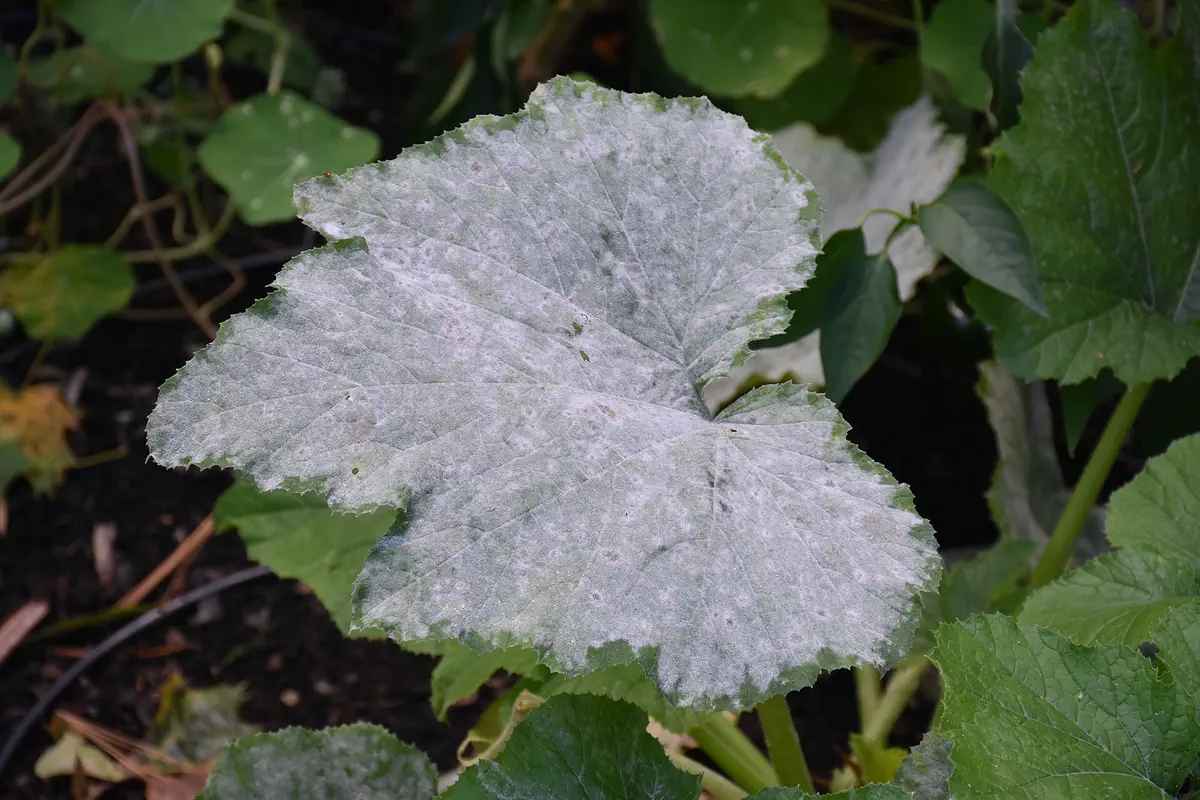
What does it look like?
- White or grey powdery patches on the upper side of leaves, sometimes stems and buds.
- Patches that spread and join until the leaf looks coated.
- Leaves yellowing, curling or drying under the powder.
Why does it happen?
- Crowded plants and poor airflow.
- Warm days and cool, humid nights.
- Plants under stress from dry soil.
What can you do about it?
- Remove the worst affected leaves and put them in a sealed bag in the bin, not the compost.
- Thin crowded stems and space plants so air can move around them.
- Water at the base of the plant in the morning and keep the leaves dry.
- For new plants, choose varieties listed as mildew resistant.
- If it keeps spreading, a fungicide labelled for powdery mildew (for example a sulfur or potassium bicarbonate product) can help: follow the label, check it is approved for home use where you live, respect the pre-harvest interval on food plants, and don't spray open flowers.
When you photograph a plant with this problem, Leafsight gives an assessment that names the likely problem, how serious it looks and how sure it is. Your first assessment that finds a problem includes care steps like these; with Pro or a one-time unlock, every one does.
When should you look closer?
- Powder on fruit, or a whole plant covered quickly.
- Spots that are dark or sunken rather than powdery: that is a different disease.
Questions
What causes powdery mildew on plants?
Powdery mildew is caused by fungi that grow on the surface of leaves. Unlike most leaf diseases, it doesn't need wet leaves: it spreads with warm days and cool, humid nights, among crowded plants with poor airflow, and on plants stressed by dry soil. It is common on roses, cucumbers, squash, grapes and some houseplants, often late in summer.
Should I remove leaves with powdery mildew?
Yes, remove the leaves worst affected by powdery mildew and put them in a sealed bag in the bin rather than the compost. Leave lightly dusted leaves on a plant that is otherwise healthy, because stripping too many leaves weakens it. Then thin crowded stems so air can move, and water at the base in the morning so the leaves stay dry.
Can powdery mildew spread to other plants?
Powdery mildew spreads by spores carried on the air, so nearby plants can be affected. Many powdery mildew fungi only infect certain plant groups, so mildew on a rose doesn't necessarily move to a squash. Still, keep affected plants spaced out, remove badly coated leaves, and check neighbouring plants of the same kind for white patches.
Can I wipe powdery mildew off the leaves?
Wiping removes the visible powder, but powdery mildew grows into the leaf surface and tends to return if conditions stay the same. Wiping is mostly useful to see how much is left. Removing the worst leaves, improving airflow and keeping the soil evenly moist do more. If it keeps spreading, a fungicide labelled for powdery mildew can be used at the label rate.
Will powdery mildew kill my plant?
Rarely on its own. Powdery mildew weakens a plant by covering leaves that then can't make as much food, so a badly affected plant grows less, flowers less and may drop leaves. Removing the worst leaves, improving airflow and keeping the plant watered at the base usually keeps it in check; a plant covered completely, season after season, may not be worth keeping.
Not sure? Check with a photo
Leafsight looks at a photo of the leaf, asks a few questions about light, watering and drainage, and gives an assessment of the likely problem with care steps. A photo assessment can be wrong: for a hands-on look, ask a local garden centre or plant clinic.
Related problems
- Black spot on roses: how to recognise it and what to do
- Tomato blight: early blight and late blight, and what to do
- Spider mites on plants: how to spot them and what to do
- White spots on zucchini leaves: powdery mildew or natural markings?
Sources
Updated 2026-11-04. All plant problems.
Also in: Español · Deutsch · Français · Português (Brasil) · 简体中文 · 日本語 · 한국어