Leaf spot: brown and black spots on leaves and what to do
Leaf spot is a group of fungal and bacterial diseases that make brown or black spots on leaves, often with a yellow ring around them. Most spread in water splashed from leaf to leaf and cause mainly cosmetic damage, so removing spotted leaves and keeping the foliage dry is the first step.
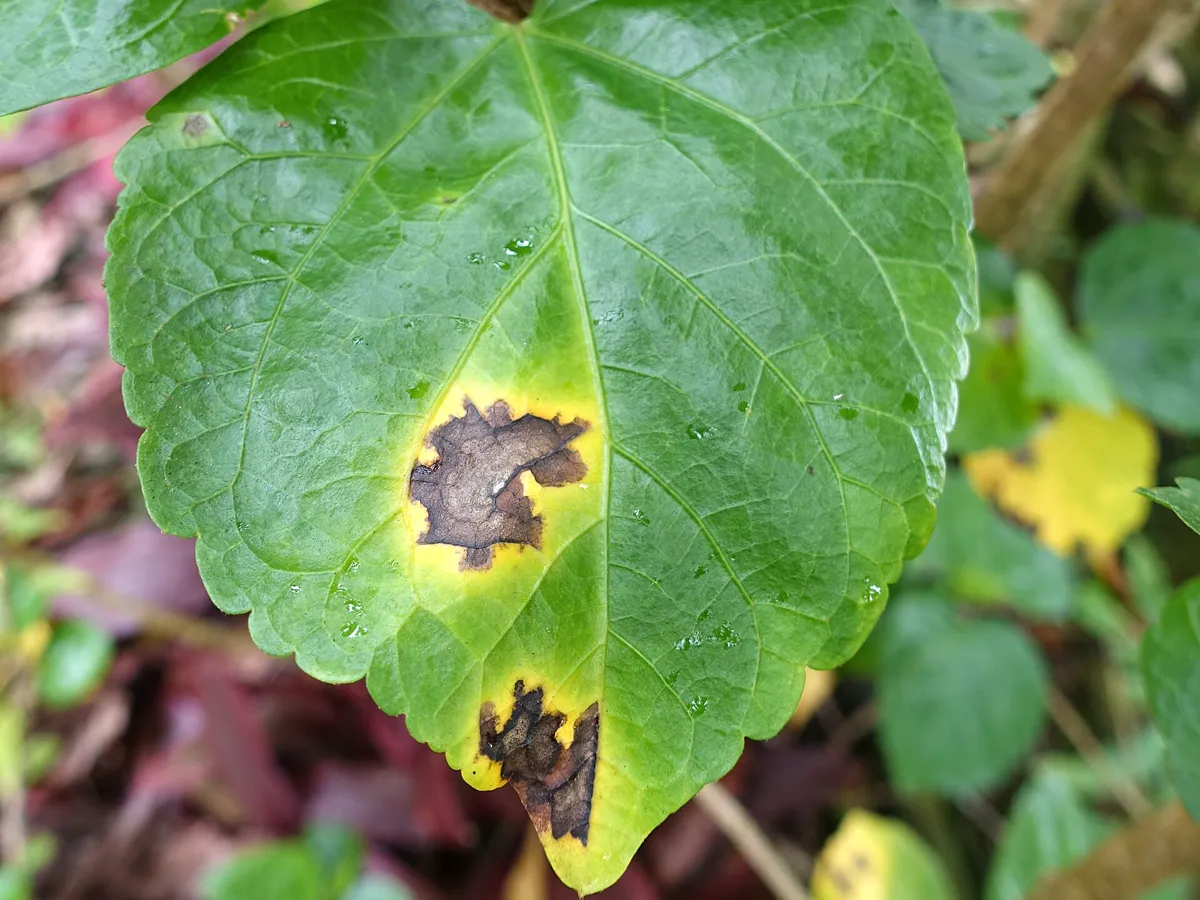
What does it look like?
- Round or irregular tan, brown or black spots with a distinct edge.
- A yellow ring, or halo, around the spots; a yellow halo around a tan to dark brown spot is a common sign of bacteria.
- Spots that grow and join into larger dead patches, until the leaf yellows and falls.
- New spots after wet weather or overhead watering, often on the lower leaves first.
Why does it happen?
- Fungi or bacteria splashed onto leaves by rain or overhead watering.
- Leaves that stay wet for long periods, in wet weather or a humid, still room.
- Infected fallen leaves and plant debris left near the plant, where the disease survives from one year to the next.
- Crowded plants with little airflow, or wounds from pruning, hail or handling.
What can you do about it?
- Pick off spotted leaves and gather fallen ones. Put them in the bin rather than the compost.
- Water the soil, not the leaves, so the leaves stay dry.
- Space or thin plants so air moves around them and the leaves dry faster.
- Clean your scissors or pruners between cuts, and avoid handling or pruning plants while the leaves are wet.
- Outdoors, add a layer of mulch so the disease on debris in the soil doesn't splash up.
- If spots keep spreading on a plant you value, a fungicide labelled for leaf spot on that plant can protect new leaves: follow the label, check it is approved for home use where you live, and respect the pre-harvest interval on food plants. Few products help against bacterial leaf spot, so the cleanup steps matter most.
When you photograph a plant with this problem, Leafsight gives an assessment that names the likely problem, how serious it looks and how sure it is. Your first assessment that finds a problem includes care steps like these; with Pro or a one-time unlock, every one does.
When should you look closer?
- Spots spreading fast over a whole plant, or appearing on stems and fruit as well as leaves.
- White or straw-coloured spots or rings on a houseplant: more often cold water splashes or too much sun than a disease.
- Spots with rings like a target on tomato leaves: see tomato blight.
Questions
What causes brown spots on leaves?
Brown spots with a distinct edge, often ringed in yellow, are usually leaf spot, a group of fungal and bacterial diseases spread by water splashing from leaf to leaf. On houseplants, white or straw-coloured spots are more often caused by cold water splashes, and pale spots by too much sun. Crisp brown tips and edges point to dry soil or dry air instead.
Should I remove leaves with leaf spot?
Yes. Pick off leaves with leaf spot and gather any that have fallen, because the fungi and bacteria survive on them and splash onto healthy leaves. Put them in the bin rather than the compost. On a plant with many spotted leaves, remove the worst first so the plant isn't stripped at once, and clean your scissors between cuts.
Is leaf spot caused by a fungus or bacteria?
Leaf spot can be either, and the two are hard to tell apart by eye. Fungal leaf spots are usually tan to brown with a distinct edge. Bacterial leaf spots often have a yellow halo around a tan to dark brown spot, though not always. The first steps are the same for both: remove spotted leaves, keep the leaves dry and improve airflow.
Will leaf spot kill my plant?
Most leaf spot diseases cause mainly cosmetic damage, especially when they appear late in the season. They matter more on small plants and on plants that lose many leaves to leaf spot year after year, because losing leaves early weakens them. Removing spotted leaves, watering the soil rather than the leaves and clearing fallen leaves each autumn all reduce the disease.
Can leaf spot spread to my other plants?
It can. Most leaf spot diseases move in water splashed from leaf to leaf, on hands and tools, and on fallen leaves left near the plant, and some affect many kinds of plants. Keep the foliage dry, clean your scissors or pruners between plants, gather fallen leaves, and give plants enough space that their leaves don't touch.
Not sure? Check with a photo
Leafsight looks at a photo of the leaf, asks a few questions about light, watering and drainage, and gives an assessment of the likely problem with care steps. A photo assessment can be wrong: for a hands-on look, ask a local garden centre or plant clinic.
Related problems
- Black spot on roses: how to recognise it and what to do
- Tomato blight: early blight and late blight, and what to do
- Fiddle leaf fig brown spots: causes and what to do
- Brown leaf tips and edges: why they happen and what to change
Sources
- Missouri Botanical Garden: Fungal spots, blights, and blotches
- Missouri Botanical Garden: Bacterial spots, blights, and rots
- RHS: Leaf damage on houseplants
Updated 2026-11-04. All plant problems.
Also in: Español · Deutsch · Français · Português (Brasil) · 简体中文 · 日本語 · 한국어